The Bandage Keeps Falling Off

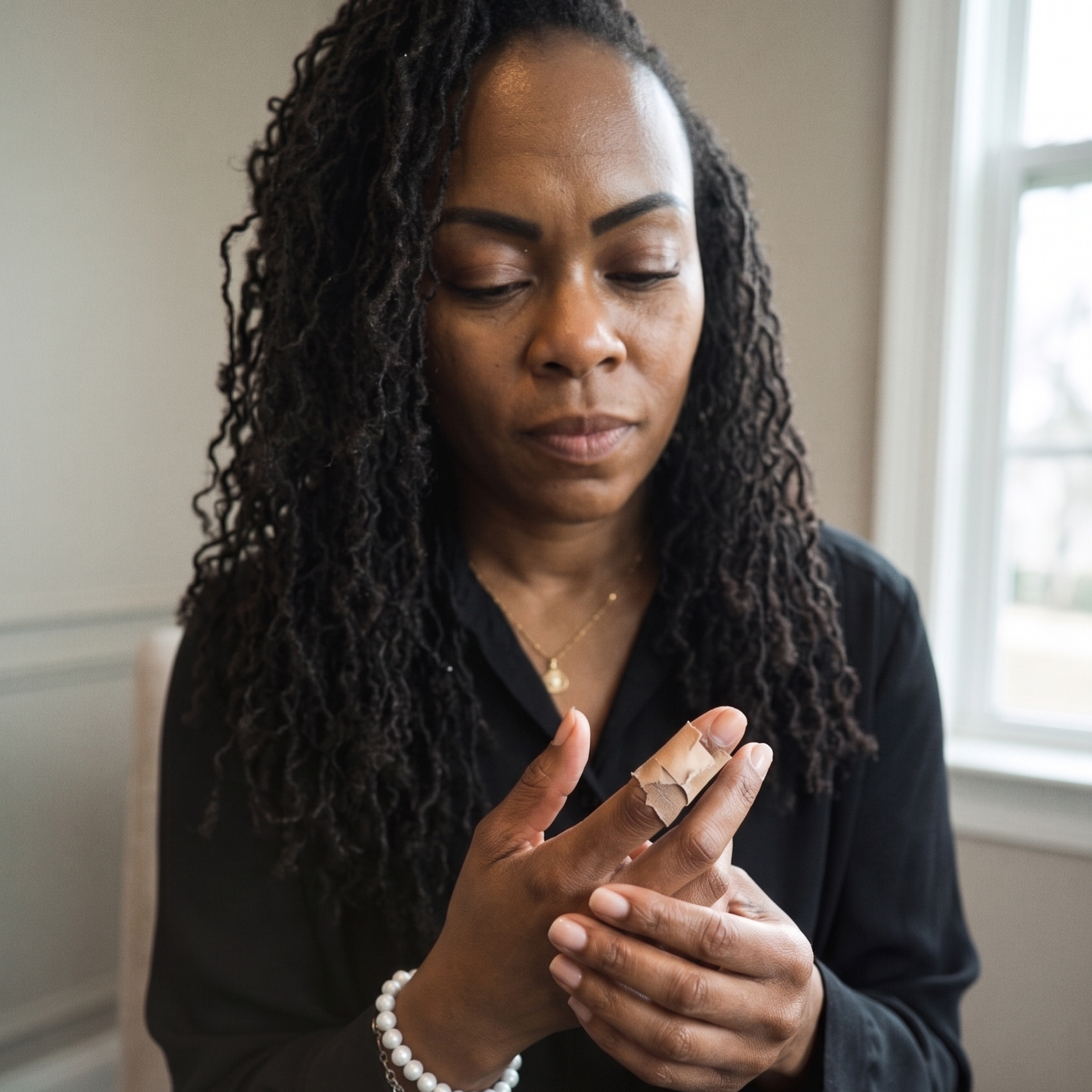
I remember getting a small cut on my hand.

Nothing major… just enough to sting.

I did what most of us do.
I cleaned it.
I added ointment.
I wrapped it up with a bandage and kept moving.

Because that’s what life teaches us, right?

Handle it… and keep going.

But the thing about having a cut on your hand is—you can’t ignore it.

You use your hands for everything.

And the bandage that was supposed to protect it?
It started to get in the way.

It got wet when I washed my hands.
It started peeling at the edges.
It looked worn out… like it had been through too much already.

So I changed it.

A fresh bandage.
A fresh start.

But nothing really changed… because I didn’t slow down.

I kept using that same hand the same way.
Still busy.
Still moving.
Still not really paying attention to what needed to heal.

After a few days, I took the bandage off.

I told myself, “It should be fine now.”

And for a moment, it felt freeing.
Like I didn’t have to deal with it anymore.

But then it started to itch.

And that itch… it was hard to ignore.

I tried to leave it alone.
I really did.

But without even thinking, I found myself touching it…
Rubbing it…
Picking at it.

And just like that, the healing slowed down.

It got red again.
A little sore again.

Not because it couldn’t heal…
But because I wouldn’t let it.


And that’s when it hit me.

The bandage wasn’t the problem.

The way I was treating the wound was.


We do the same thing to ourselves. 

We go through something painful… something that leaves a mark.

We cover it up quickly.
Tell ourselves we’re fine.
Keep showing up for everything and everyone.

We don’t rest.
We don’t slow down.
We don’t really take care of what’s underneath.

Then when we finally try to “move on,”
we don’t give ourselves the patience healing actually requires.

We go back to old situations.
We revisit old thoughts.
We pick at things that were trying to close.

And then we wonder why it still hurts.


Taking care of yourself isn’t just about fixing the problem.

It’s about giving yourself the time and space to actually heal.

It’s about knowing when to step back.
When to stop touching what’s sensitive.
When to let things be… even if they feel uncomfortable.

That’s how we treat ourselves.

We cover our pain.
We tell ourselves we’re okay.
We try to “fix it” quickly.

But we don’t give ourselves time.

We keep going back to what hurt us.
We keep touching the same wound.
We keep reopening what was trying to close.

Not because we want to stay hurt…

But because we don’t know how to leave it alone.

Because healing doesn’t need constant attention.

It needs consistency.
It needs patience.
It needs you to stop reopening the same wound.

If you truly want to heal, you have to start treating yourself with care.

Not just once… but daily.

Slow down.
Protect your peace.
And stop picking at what’s trying to heal inside of you.

Stop checking on what’s healing just because it feels different. Sometimes, the discomfort you feel isn’t pain… It’s progress learning how to exist without the wound.
Quiana Brown
I'm Overweight

I’m overweight.

And for a long time… I thought it was just my body.

Until I realized—
my body wasn’t the only thing carrying weight.

It was my heart.
My mind.
My spirit.

And no one could see it.


I walk into rooms smiling…
but I’m carrying 10 pounds of problems I never talk about.

I laugh with people…
but I’m dragging 30 pounds of a past that still whispers my name when I’m alone.

I say “I’m fine”…
while 15 pounds of fear sits quietly in my chest.

I hold conversations…
with 20 pounds of hurt and anger I never released.

I try to stay strong…
but 10 pounds of anxiety won’t let me rest.

I keep pushing forward…
with 35 pounds of trauma that never got the chance to heal.

I second guess myself…
because 15 pounds of doubt follows every decision I make.

And I show up for everyone…
while carrying 35 pounds of being everything to everybody—
except for myself.


That’s a total of 170 pounds.

170 pounds! … and nobody noticed.

How could they?

Because I carried it so well.

Because I made it look normal.

Because I convinced myself that this was just “life.”


But the truth?

I got tired.

Not the kind of tired that sleep can fix.

The kind of tired that sits in your soul…
the kind that makes you question who you even are anymore.

I looked at myself one day and didn’t recognize WHO I WAS!.

Not because I changed…

But because I disappeared under everything I was carrying.


And the hardest part?

No one told me to put it down.

So I kept holding it.

I held onto people who hurt me.
I held onto moments that broke me.
I held onto expectations that were never mine.

I held… and held… and held…

Until it started breaking me.


If I don’t let this weight go…

I already know what happens.

I stay here.

Stuck.
Heavy.
Smiling on the outside… while slowly falling apart on the inside.

I keep pouring into others…
until there’s nothing left of me.

I keep surviving…
but never really living.

And that… that scares me more than anything.


So today…

I made a decision.

Not a loud one.
Not a perfect one.

Just a real one.

I’m going to start letting it go.

Not all 170 pounds…

But something.

Maybe 1 pound today.

Maybe it’s saying “no” without guilt.
Maybe it’s not replaying that painful memory tonight.
Maybe it’s choosing rest instead of proving my worth.

Maybe it’s finally admitting…

“I’m not okay.”


Because healing doesn’t start when everything is fixed.

It starts when you stop pretending.


If you’re reading this…

I NEED YOU TO HEAR ME.

I know you’re carrying things you don’t talk about.
I know you’ve been strong for longer than you should have had to be.
I know you’re tired in ways you can’t explain.

And I wish I could sit with you right now…
look you in your eyes…
and tell you gently—

You don’t have to carry all of that anymore.

You really don’t.

So for a moment…

Breathe.

Release your shoulders.
Unclench your jaw.
Let your heart soften just a little.

This is your virtual hug.

You’re allowed to put something down today.

Even if it’s small.
Even if it feels unfamiliar.
Even if you don’t know what comes next.


Start building a relationship with yourself.

One where you choose you.
One where you love you.
One where you stop abandoning yourself to be accepted by others.

Because you deserve that kind of love too.


Does this Resonate? 

You are not overweight because of your body…

You are overwhelmed because of everything you’ve been carrying alone.

And healing begins the moment you decide—
with love, not force—
to finally put it down.


Some of the heaviest weight you’ll ever carry isn’t on your body… it’s in your heart. And the bravest thing you’ll ever do is love yourself enough to finally let it go.
Quiana Brown
I Abandoned You

You left without saying goodbye.

I wanted you to stay.
I've been with you this whole time, even when you didn’t want me there.
When you drifted away, I felt lost… almost afraid.

You couldn’t feel the love I had given you.
And somehow, the more and more you loved me, the further you moved away.

At least, that’s how it felt.

But the truth is deeper than feelings.

For a long time, I thought you had abandoned me.

You stopped listening.
You stopped trusting.
You stopped believing in what we once built together.

But if I’m being honest, something else was happening beneath the surface.

You weren’t abandoning me.

You were abandoning yourself.

Not intentionally. Not maliciously. Not out of weakness.

But out of exhaustion, doubt, and the quiet weight of criticism you had carried for years.

The kind that whispers:

You’re not ready.
You’re not enough.
You should be further along.
What if you fail?

So you paused your growth.

You ignored the adjustments life was asking you to make.

And slowly, you began shrinking inside your own life.

The analytical mind sees patterns others often miss.

And when I look closely at your story, I see something important.

Every moment you call yourself lost…
you were actually standing at the edge of transformation.

Every moment you believed you weren’t enough…
you were preparing to grow into someone stronger.

But criticism—especially the kind we give ourselves—can distort reality.

It makes progress look like failure.
Learning looks like a weakness.
Starting over looks like defeat.

So instead of moving forward, you stepped away from yourself.

You convinced yourself that staying small was safer than discovering how powerful you really are.

Let’s pause and examine this the way an analytical thinker would. (WAKE UP!)

STOP… The evidence shows something so surprising.

You’re still here!

You’re still searching!  Still reflecting! Still trying to understand yourself!

People who truly give up don’t ask questions.

But you did!

Which means something inside you never left.

Your courage! Your awareness! Your potential!

They were simply waiting for you to return.

Growth rarely announces itself in comfortable ways.

Sometimes it looks like confusion.

Sometimes it feels like loneliness.

Sometimes it sounds like silence after everything familiar disappears.

But what feels like abandonment is often transition.

You were never meant to stay the same person forever.

Life is asking you to adjust, expand, and see yourself differently.

Not through the lens of criticism.

But through curiosity.

Imagine looking inward not with judgment, but with understanding.

Instead of saying:

“Why am I like this?”

You begin asking:

“What is this moment trying to teach me?”

That single shift changes everything.

Because when you stop attacking yourself, you finally create space to grow.

And growth doesn’t come from shame.

It comes from compassion.

You are bigger than the version of yourself that doubt created.

Brighter than the voice that tried to dim your light.

Stronger than the moments that convinced you to give up on yourself.

You were never behind in life.

You were simply learning how to see yourself clearly.

And clarity is powerful.

It rebuilds confidence.

It opens doors inside your mind that fear once closed.

Most importantly, it reminds you that the person you thought abandoned you…

was actually waiting patiently for you to come home to yourself.

The Moral of the Story

A person can travel the world searching for purpose, confidence, and belonging, only to realize they left those things within themselves.

When we slow down, examine our thoughts, and replace harsh judgment with understanding, we rediscover something powerful:

We were never broken.

We were simply growing.

The moment you stop abandoning yourself is the moment your life begins to expand in ways you never imagined.


— I Abandoned You

Quiana Brown
The Asphalt

Have you ever noticed how often—almost too often—you’re driving down the road, and suddenly you see orange signs flashing ahead? “Construction. Expect Delays.” Another lane closed. Another stretch of pavement ripped up. And in that moment, you roll your eyes and think, “Didn’t they just fix this road? I’m going to be stuck in traffic. Again. Why can't they do this overnight? I just don't understand.”

But there’s a reason for the mess.
Repaving is necessary when the foundation beneath has cracked. When potholes become too deep to fill. When the damage is no longer just surface-level.

The road isn’t being punished—it’s being restored.

And just like that, it mirrors us.
You. Me. All of us.

We go through life carrying thoughts, beliefs, and habits that have been layered onto us over years—decades even. We’ve paved our minds with memories of rejection, buried guilt, silent battles, and fears we never speak of. Our thoughts, like worn-out roads, start to buckle under the pressure.

We smile on the outside, but inside…
Some of us are barely hanging on.
The foundation is cracked.
And we keep patching it up, hoping it holds.

But what if it doesn’t?

What if the quiet thoughts you try to ignore—“I’m not enough,” “Nothing ever works out for me,” “I’ll always be this way”—have become the potholes of your soul? You swerve around them in conversation. You cover them with busyness, accomplishments, filters, or silence. You try to avoid the places in yourself that ache the most.

But eventually, even the strongest roads give out.
Because patching is only temporary.

Repaving is transformation.

Repaving means stopping long enough to listen to the pain.
It means digging deep into the layers of who we’ve been so we can make space for who we’re meant to become.

It’s not pretty. It’s not quick. It’s not comfortable.
But it’s healing. It’s freeing. It’s necessary.

Your thoughts matter more than you think. The way you speak to yourself when no one’s listening matters. That quiet narrative running through your mind? It's either paving the way for peace—or slowly wearing you down.

Some of us are driving through life with thoughts so destructive, so deeply torn and battered, that the journey becomes unbearable.

And yet, we keep going.

But what if today…
You pulled over.
You got out.
And you looked down at the road you’ve been on.

You’d see the cracks. The wear. The weight you’ve carried.
But you’d also see something else.

The potential for renewal.

You are not broken beyond repair.
You are worthy of being rebuilt.

And like the road beneath your feet, you too can be stripped of the old, smoothed by healing, and made whole again.

So, the next time you’re stuck in traffic, waiting for the asphalt to be repaved—pause.
Let it remind you of what’s possible.
Let it remind you that change takes time.
And that beauty begins beneath the surface.

When the weight of the past wears you thin, don’t patch the pain—repave your peace.
Quiana Brown
Color Outside the Lines

I still remember the first time I picked up a crayon.
It was yellow, stubby, wrapped in torn paper, warm from my small hand.
At that moment, I didn’t know what this thing was.
I didn’t know it held power to create suns, lions, or whatever my young mind could imagine.

All I saw was mom or dad handing me paper,
and showing me how to move this magical stick back and forth,
leaving trails of color like footprints across a blank world.
I giggled at the marks, not caring where they landed,
finding joy in the simple act of seeing something appear where once there was nothing.

Then we got older.
We were introduced to the coloring book.
A book filled with princesses, trucks, and superheroes,
and more crayons to choose from—blue that could be water or sky,
green that could be trees or dragon scales,
and that one pink crayon that somehow always went missing.

We began to develop our ability to be “creative.”
The pages had lines, and we noticed the black outlines that formed the shapes.
Our crayon now had a playground:
lines to bounce between, curves to loop around, spaces to fill with joy.

As the world turned and we grew up,
our coloring tactics became clearer, and with them came an invisible rule:
Stay inside the lines.
Color carefully.
Make sure it looks right.

Isn’t that how life sometimes feels?
We’re taught to color inside the lines of every chapter—
go to school, get the degree, climb the ladder, pay the bills, smile at the camera,
hold it all together, stay in the neat boxes.

But where is that childlike curiosity now?
Where is the joy that came from moving your crayon back and forth,
not caring if the sky was orange or the grass was blue?

What if we stepped back into that time when it didn’t matter about the lines?
When it was about the moment,
the giggle of creativity,
the curiosity that brought you joy even when your rainbow had a brown streak running through it.

Life is not about staying perfectly within the lines.
Sometimes your lines will blur,
sometimes your pages will tear,
sometimes your colors will run together,
and it will still be your masterpiece.

The pages of the coloring book are the chapters of your life,
and you, dear friend, are the crayon.
Build that curiosity as you get older.
Color wildly.
Ask questions.
Take risks.
Doodle on the margins.
Let yourself feel the joy of coloring outside the lines again.

Because sometimes, the most beautiful parts of your life will happen
when you let your colors bleed beyond what you thought was allowed.

Don’t just live within the lines you were given. Draw your own, color outside of them, and call it your life.
Quiana Brown
The Check Engine Light

Who likes when the check engine light pops up on your vehicle?

I know I don’t.

Your day is going well, and then bam—there it is, that tiny glowing symbol on your dashboard screaming,

“Hey, something’s not right.”

It’s called the malfunction indicator lamp (MIL), a gentle yet persistent reminder that your vehicle’s onboard computer has detected a potential problem with your engine, transmission, or emissions system.

It doesn’t tell you exactly what’s wrong, but it warns you that something is off and needs attention.

And suddenly, your thoughts start racing:

“Is this something small?”
“Is it going to cost me thousands?”
“Can I make it home?”
“Should I ignore it for now?”

A steady light might mean a minor issue; a flashing light could mean a critical problem requiring immediate care.

We get worried because we know ignoring it can lead to breakdowns, higher costs, decreased fuel efficiency, and, eventually, a vehicle that leaves us stranded.


Then it hit me:

I am the vehicle.

You are the vehicle.

If we don’t check our own engine light, the engine that would can become the engine that could have. The engine that didn’t becomes the engine that couldn’t.

And sometimes, our personal MIL is flashing, but we ignore it.

  • Feeling burnt out but pushing through because “I don’t have time to rest.”

  • Doing too much at once, living in a swirl of deadlines and “shoulds.”

  • Caring for everyone else but yourself, refilling their cups while letting yours run dry.

  • Working non-stop, leaving no time to play or breathe.

  • Thinking independence means you don’t need anyone, yet aching for a fulfilling partnership but feeling “too busy” to cultivate love.

  • Or maybe you’re in a relationship but not giving it your time, energy, and presence, because your mind is stuck in overdrive, never finding the off switch.


You deserve more than survival mode. You deserve more than living with your “check engine” light on, hoping it will magically disappear.

Because here’s the truth:

If you don’t check your engine light, you will eventually cause a serious personal MIL.
Mental. Internal. Life-altering.

Ignoring your needs isn’t a badge of honor. It’s a slow erosion of your well-being.


So, check your engine light:
✨ Take that mental health day.
✨ Pause and breathe.
✨ Check in with yourself, honestly.
✨ Get therapy or coaching if you need support.
✨ Say “no” sometimes so you can say “yes” to what truly matters.
✨ Allow yourself to rest, to laugh, to play.
✨ Allow yourself to be loved and to love back.
✨ Refuel your soul.

Your vehicle—your body, your mind, your spirit—deserves the tune-up. It deserves the oil change. It deserves the tender care that prevents breakdowns and burnout.

Because you are not replaceable.

Your engine light is a gift, not a curse.

Don’t ignore it.

Take care of your body; it’s the only place you have to live.
— Jim Rohn
Quiana Brown
The Asphalt

Have you ever noticed how often—almost too often—you’re driving down the road, and suddenly you see orange signs flashing ahead? “Construction. Expect Delays.” Another lane closed. Another stretch of pavement ripped up. And in that moment, you roll your eyes and think, “Didn’t they just fix this road? I’m going to be stuck in traffic. Again. Why can't they do this overnight? I just don't understand.”

But there’s a reason for the mess.
Repaving is necessary when the foundation beneath has cracked. When potholes become too deep to fill. When the damage is no longer just surface-level.

The road isn’t being punished—it’s being restored.

And just like that, it mirrors us.
You. Me. All of us.

We go through life carrying thoughts, beliefs, and habits that have been layered onto us over years—decades even. We’ve paved our minds with memories of rejection, buried guilt, silent battles, and fears we never speak of. Our thoughts, like worn-out roads, start to buckle under the pressure.

We smile on the outside, but inside…
Some of us are barely hanging on.
The foundation is cracked.
And we keep patching it up, hoping it holds.

But what if it doesn’t?

What if the quiet thoughts you try to ignore—“I’m not enough,” “Nothing ever works out for me,” “I’ll always be this way”—have become the potholes of your soul? You swerve around them in conversation. You cover them with busyness, accomplishments, filters, or silence. You try to avoid the places in yourself that ache the most.

But eventually, even the strongest roads give out.
Because patching is only temporary.

Repaving is transformation.

Repaving means stopping long enough to listen to the pain.
It means digging deep into the layers of who we’ve been so we can make space for who we’re meant to become.

It’s not pretty. It’s not quick. It’s not comfortable.
But it’s healing. It’s freeing. It’s necessary.

Your thoughts matter more than you think. The way you speak to yourself when no one’s listening matters. That quiet narrative running through your mind? It's either paving the way for peace—or slowly wearing you down.

Some of us are driving through life with thoughts so destructive, so deeply torn and battered, that the journey becomes unbearable.

And yet, we keep going.

But what if today…
You pulled over.
You got out.
And you looked down at the road you’ve been on.

You’d see the cracks. The wear. The weight you’ve carried.
But you’d also see something else.

The potential for renewal.

You are not broken beyond repair.
You are worthy of being rebuilt.

And like the road beneath your feet, you too can be stripped of the old, smoothed by healing, and made whole again.

So, the next time you’re stuck in traffic, waiting for the asphalt to be repaved—pause.
Let it remind you of what’s possible.
Let it remind you that change takes time.
And that beauty begins beneath the surface.

When the weight of the past wears you thin, don’t patch the pain—repave your peace.
Quiana Brown
Blueprint of Courage (and a Few Loose Screws)

You ever look around your life and think, “Who built this mess?”

The foundation is cracked. The mental roof is leaking. Some days, your motivation is missing entirely—probably hiding under the couch with that one sock from 2017. You try to keep it together with mental duct tape, a half-used affirmation, and a coffee stronger than your Wi-Fi signal. Welcome to adulthood: the renovation project no one warned you about.

But here’s the kicker…
You’re not broken.
You’re just under construction.

Imagine your mindset like a house. Not a Pinterest-perfect one—more like one of those fixer-uppers from a reality show where the walls are crooked, the plumbing makes questionable sounds, and there's a mysterious draft even when all the windows are shut. That’s your brain some days.

And guess what? That’s okay.
Because every house—every mindset—needs maintenance.

See, somewhere between your 20s and now, life probably handed you a toolbox full of weird tools: comparison wrenches, perfectionism nails, and a hammer labeled “Just Get Over It.” You’ve been trying to build a stable life using whatever you could grab… but the screws don’t match and the instruction manual is in another language. No wonder it feels like you're holding it all together with hope and expired tape.

But here’s the truth no one told us:
Mindset isn’t something you’re born with—it’s something you build.

And yeah, sometimes you have to tear down old walls—like those limiting beliefs that whisper, “You’ll never change” or “This is just who I am.”
Spoiler alert: walls can talk… and lie.

So let’s start there. Knock those suckers down.
Replace self-doubt with drywall made of curiosity.
Lay floorboards of forgiveness.
Insulate with kindness.
Add windows so light can actually get in.

And don’t forget a solid foundation—because your thoughts are the blueprint, and if they’re built on anxiety, people-pleasing, or what your aunt said about your life choices in 2012… the house will wobble every time life sneezes.

But here’s the twist:

This messy, loud, confusing renovation?
You’re not doing it wrong.
You’re just finally doing it right.

Because building a mindset that actually serves you takes guts.
It takes humor.
It takes laughing at yourself when you glue your fingers together emotionally for the third time this week.

And yes, there will be dust, tears, splinters, and maybe a meltdown in aisle 7 of Home Depot. But there will also be pride. Clarity. Moments where you look around and say, “This is mine. I built this.”

So keep swinging the hammer.
Keep misreading the instructions and figuring it out anyway.
You’re not falling apart—you’re being remodeled into something stronger, wiser, and way more fabulous.

We are each the architect of our peace, building with courage, chaos… and a few crooked shelves.

 —Blueprint of Courage (and a Few Loose Screws)

Quiana Brown
Who's Driving?

You ever wake up and feel like life forgot to put the car in Drive?

Like somehow, you’re moving, but it’s backwards. The days blur into each other. You’re brushing your teeth, replying to emails, scrolling through your phone — and yet, every motion feels like you’re rewinding instead of moving forward. The same old thoughts. The same old wounds. Caught. Trapped.

You start wondering, Why does it feel like I’ve been living in reverse?

It’s like your past decided it was time to grab the wheel. Trauma. Depression. Guilt. Fear. They climb into the car like they paid for premium seats. They don’t even ask — they just slide in, adjust the mirrors, and whisper, “You good back there?”

And we let them.

We let the past — the years, the months, the days — consume our present like it's a leftover meal. We microwave the same thoughts, over and over, hoping they’ll somehow taste different.

But here’s the truth: That reverse gear? It’s seductive. It gives us the illusion of movement without ever demanding direction.

You ever just want to escape?

Sleep all day. Get out of bed. Go for a walk. Maybe run until your legs scream louder than your thoughts. Book a flight and leave your life behind for a few days. Not because you’re adventurous — but because you’re desperate.

And still, the question loops in your head:
Why can’t I shift the gear? Why is it so loud? Leave me alone..

Well, let me ask you this:
If you were standing outside your own car, watching yourself in this moment — what would you say to that version of you behind the wheel?
Would you knock on the window and say,
"Hey… you okay?"
Or would you shout,
"What are you doing!? You’re letting your fear parallel park your purpose!"

Whatever you'd say — say it. Now. Out loud. Or whisper it if you need to. Just make sure it reaches the driver.

Now take a breath.
Put your hand on the wheel.
Feel that trembling? That’s power waking up.

The truth is: You are in the driver's seat.
But your thoughts? They're chilling in the passenger seat with a bag of chips and a lot of opinions. That’s cool. Let them snack. But you decide the route.

Look into that rearview mirror — not to live in it, but to leave it behind.

See the trauma? Wave to it. See the fear? Nod at it. The depression? Yeah, give it a smirk.
Then say,
"You’ve been here long enough. But I’m driving now."

Hand on the gear.
One deep breath.
Now say it:
“Shift.”

You may hear your thoughts push back,
"Wait… is this safe?"
"Where are we even going?"
"I don’t want to mess it up again."

And you say,
“It’s okay. Put your seatbelt on. I got this.”

Turn on your inner navigation — not the one that tells you where you should be, but the one that reminds you who you are.
Strong. Worthy. Capable. Healing. Human.

And as the engine hums, the past gets smaller in the mirror.

You’re no longer stuck. You’re shifting. You’re driving.

Your past is a place of reference, not residence. Your future deserves a better driver.

So I ask you…
Who’s driving?

Quiana Brown
Pouring in Myself

There’s a certain kind of magic in the air before it rains. A stillness. A whisper. A knowing.

That magic isn't just in the skies—it's in me.

You see, I play a major part in this world. While rising from the atmosphere, sometimes unnoticed, I carry more than anyone knows. Even during unexpected, unforeseen days, I find myself too cold to continue, unable to withstand my own emotional weather. I freeze in mid-air, unsure if I’ll ever feel the sun again.

At times, I thought I was too “cool” for life’s lessons. I tried to float above it all, detached and untouchable. But my ability to stay self-absorbed wasn’t strong enough—because deep down, I was meant to give. I didn’t realize how much weight I was holding until the pressure was too much to bear. I had taken on more than I ever imagined.

So I fell.
In an overcast moment—gray, heavy, and honest—I came down.

But don’t be alarmed.

Because I didn’t fall to break.
I fell to nourish.
I fell to grow.
I fell to pour in myself.

Yes, there’s precipitation in the air, and the beauty of white clouds tells a story we too often forget: we rise, we gather, we carry, and eventually—we release. That’s what makes us beautiful.

Updrafts from warm winds lift droplets higher into the sky, allowing them to cool and condense into clouds. These clouds, fluffy and full of potential, hold a collection of tiny droplets—each one unique. Over time, as droplets grow in size and weight, gravity calls them home, and they fall as rain.

That rain?
It’s not just water.
It’s a return. A cycle. A becoming.

I realize now—I am that droplet.
You are too.

We are all born uniquely, shaped by the skies we come from, influenced by our journeys through heat and cold, light and shadow. And when the time is right, we pour into ourselves and the world around us.

Rain is not weakness.
It’s the reward of becoming full.
It’s the evidence of having lived, carried, and transformed.

And it’s no coincidence that rain brings life wherever it touches.

So next time you feel the weight, remember: it’s only a part of your process. You are not breaking—you’re preparing to pour.

One day, you will tell your story of how you overcame what you went through, and it will be someone else’s survival guide.
— Brené Brown

Let the rain remind you: You matter. You’re rising. You’re becoming.

And when it’s time—you’ll pour in yourself.


Pouring in Myself 💧

Quiana Brown